
Consumption Part One: The Two Intangible Sources of Luxury

Happy Victim of 'Vivienne Tam' in Japan
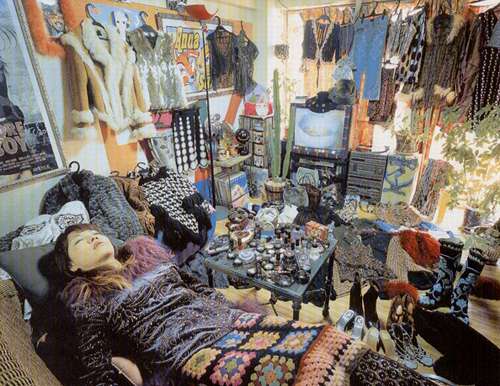
Happy Victim of 'Anna Sui'
Well, I finished the book. It was amazing. A real page turner and I highly highly recommend this book to anyone even those who aren't really into the industry. It's a great, eye opening read on how things are being run these days. Totally messed up. I'm going to quote from Dana Thomas' book so bear with me.
'Happy Victims': noun. Dubbed by photojournalist, Kyoichi Tsuzuki, these people are victims of brand marketing, the items seem to bring them a soft of happiness.
Case #1
There is a Buddhist monk who collects Comme des Garcons religiously. Once a month, the monk sheds his robes, dons Comme des Garcons' avant-garde constructionist clothes, and heads from his temple to Tokyo to pick up a few more pieces. He is so convinced of their miraculous powers that he says his delinquent ister cleaned up her act when she started wearing Comme des Garcons.
Case #2
...a Martin Margiela manic who is so fastidious about his collection that he never cooks at home because he doesnt want the clothes to retain the odors. The only thin in his refrigerator is eyedrops. "when he gets thirsty," Tsuzuki said, "he goes to a convenience shop and drinks there and then goes back home. He does not want to put any kind of trash in the room."
-------------------------------------------------------
Ugh, having so much 'luxury' actually looks kind of cheap.
There's no eloquent words to say this, but after I finished 'Deluxe: How Luxury Lost its Luster', but the so-called world of luxury, CEOs of these companies and all those who create counterfeit goods and those who buy counterfeits, make me sick.
But how did luxury companies go from selling high end things to becoming global corporations?
Most luxury companies such as Gucci, Louis Vuitton, Hermes and Chanel started off as small and humble family businesses run by relatives who catered fine goods to a small number of elite. In a nutshell, marketers and businessmen come in and take over the companies, use the already built up prestigious name and start marketing like crazy. How? Magazine ads, company sponsored events like car racing, launch parties, issuing out four new perfumes per year, build grand stores, give free clothes (and even pay them to wear them at the Oscars) to actors and actresses who can afford to buy the clothes. The idea is to bring luxury to the masses. The dilemma lies here: if luxury is accessible by all (the other day as I was walking to church, I saw a group of five females from age 10 to 40 all wearing the exactly same Louis Vuitton backpack. Whether or not they are real, they looked cheap), then the things or ideas we identify as 'luxury' must change for luxury is not supposed to be attainable by all.
As Thomas said in her book, "consumers don't buy luxury branded items for what they are, ut for what they represent. And good fakes- the kind that can pas for real- now represent socially the same thing as real." p280
It's true. I wrote about this a year ago about how women buy expensive purses to somehow 'add value' to their own lack of self esteem. Now, in order to bring luxury to the masses, the object itself, is not marketed but the qualities that you will be endowed with upon point of purchasing this item.
What makes it even worse, is that people who cannot afford a $700 bag, are purchasing fakes to maintain a facade of wealth, taste and status. This not only feeds the counterfeiting business that earns hundreds of millions a year, it's a low risk business thus crime gangs and terrorists get into the industry:
"Counterfeiting flourishes because it is a high-return, low-risk business: counterfeiters can earn millions and are rarely caught. "the markup is like heroin. Say I buy one ounce of heroin for $18,000. Diluted one to ten, I now have $180,000 worth. However, conspiracy to commit a crime and criminal possession of narcotics is an A-i felony in New York. If I'm caught with any part of that ounce of heroin, I'm looking at eight to twenty-five years, and life if it's a multiple offense. It's mandatory sentencing. It's almost like murder.
If I brought in $18,000 worth of handbags in from China"- which would retail for at least 10 times more- "you'd put me in jail overnight, maybe. And I'd call my lawyer and be out in the morning. Ninety-nine percent of the people caught in New York state selling counterfeit goods do not go to jail." p292-3
Stunning. Why do drugs when you can do purses.
This part made me cry,
"The children who work in counterfeit factories are usually housed by owners; the kids in the raid I witnessed lived across the couryard in slum dorms. When a counterfeit factory is raided and the owner arrested, the children are left not only out of work but also homeless... Sometimes the cases are truly horrific, "I remember walking into an assembly plaint in Thailand a couple of years ago and seeing six or seven little children, all under ten years old, sitting on the floor assembling counterfeit leather handbags... The owners had broken the children's legs and tied the lower leg to the thigh so the bones wouldn't mend. He did it because the children said they wanted to go outside and play." p288
Most people don't understand the implications of their actions. They believe that if they can purchase a fake Chanel (apparently the fake Chanel bags go across the border with the logo as 'CO' but there's a part of the sticker in the second 'O' that peels back to create the interlocking C's of the Chanel brand which are removed once safe through customs. I thought that was pretty funny actually- kinda creative) they are doing nothing wrong- the luxury companies earn so much money anyway, that it wouldn't matter if they purchased a $100 knock off. You do more damage than you think.
And China is astounding- as usual. On one hand, while the majority of counterfeits come from HK ($125 million in 2005-2006), it is becoming a huge money pot. In terms of economic growth and the number of people who are so rich, apparently they're 'richer than air' according to Karl Lagerfeld, Chanel designer. And all of them come from China. Couture dresses start at $100,000. You are considered a regular customer of a couture house if you purchase a minimum of five dresses a year: that's approximately $500,000. Half a million. And many of those regulars are from China. There are more Chanel boutiques in tiny little Hong Kong than there are here in New York. People there are hungry, they're hungry for things that were forbidden during the Cultural Revolution.
*
All this is insane. I can't begin to comprehend the madness in all this. However I do understand, to an extent, because I go to a fashion school that has a uniform of skinny jeans, Chanel sunglasses, and Marc Jacob bags. The pressure to wear your self worth on your sleeve is incredible. Brands have become symbols representing taste, style and prestige, not quality and craftmanship within the object itself. Counterfeiting won't stop until people stop buying logos for logos.
So what now? If everyone can afford the $1000 It bag, the Tiffany pendant, the Cartier jewels and the Jimmy Choos, what is luxury if everyone has it?
Personally, I see that it all comes down to two things. Two things that everyone wants whether they are conscious of it or not:
-Confidence
-Time
In a world that is so absorbed with the self, we have become our own walking talking critic, sitting in the sidelines watching ourselves in the eyes of a passerby. Objects of desire, the quilted Chanels to Swarovoski crystals to some fancy luxury sportscar, all connote this idea of confidence. As symbols of prestige they all give off this idea of confidence. But I think true luxury is a confidence that radiates from the self and warms them people around it.
Time- kind of obvious why. We have so little of it, if we could buy things that connote a period of time, that must signify a certain value over things of the present. It's the commodification of time: Vintage wine, vintage clothing, antique cars, antique furniture, antique books. Things that have survived over a certain time frame are valued over objects of the present. Though we may not have lived in the time it was created, owning an object that connotes a certain span of time is a symbol of a cultured person.
Another aspect of time is the time it takes to create an object. This kind of time also applies to those objects that are considered vintage or antique. However it applies to, say, an Hermes bag which takes 15 hours to create or a Rolex with the parts individually placed inside. They may not be vintage but the time that is used in labour, becomes valuable. Who doesn't like the idea that someone took sweat, care and time into an object? It creates both a monetary and an intangible sense of value.
I was thinking today, why is it that we are constantly living in the past (the purchase of antiques or the feelings of nostalgia or the surfacing of memories) or living in the future (in the case of fashion) and never the present? I feel like we've lost something here- something has slipped through our fingers.
In the next entry I will write (most likely after this church retreat), I will address this issue of nostalgia as I read from an excerpt of a book called 'Modernity at Large' by Arjun Appadurai. It talks about how nostalgia is created through the value of time- and how we live in the present through the past- a past that we never really experienced.


0 Comments:
Post a Comment
<< Home